


Creatine is defined as the most research-backed supplement for increasing strength, power, and lean muscle mass in resistance-trained athletes. If you want to use creatine for strength gains that actually move the needle, you need to understand the mechanism, the protocol, and the non-negotiables. This isn’t a “maybe it works” conversation. A meta-analysis of 37 randomized controlled trials found a +3.39 kg fat-free mass increase when creatine is combined with resistance training. That’s not a rounding error. That’s the difference between a plateau and a PR.
How does creatine enhance strength at the cellular level?
Creatine works by replenishing phosphocreatine stores in your muscles, which directly fuels ATP regeneration during short, high-intensity efforts. ATP is your body’s primary energy currency. When you’re grinding through a heavy squat set or pushing a max bench, your ATP depletes within seconds. Phosphocreatine donates a phosphate group to rebuild ATP on the spot, keeping you explosive and powerful through those critical final reps.
“Creatine boosts phosphocreatine stores, fueling short-duration, high-intensity activities like sprinting, heavy lifting, and explosive movements where anaerobic energy dominates.”
This effect is specific to anaerobic work. Creatine does not meaningfully improve aerobic endurance or long-duration cardio performance. Its power lives in the 1 to 30-second effort window, which covers virtually every set you perform in the weight room. That’s why powerlifters, Olympic weightlifters, and strength athletes have used it as a staple for decades.
The anaerobic power improvements creatine delivers are consistent even without structured resistance training. This means creatine’s energy system benefits are real regardless of your training status. But to convert that raw power into actual muscle and strength, you need the training stimulus. More on that shortly.
What are the best creatine protocols for strength gains?
Creatine supplementation follows two proven dosing strategies, and both work. The difference is speed of saturation, not the final outcome. The ISSN Position Stand on creatine, which reviewed over 500 studies, lays this out clearly.
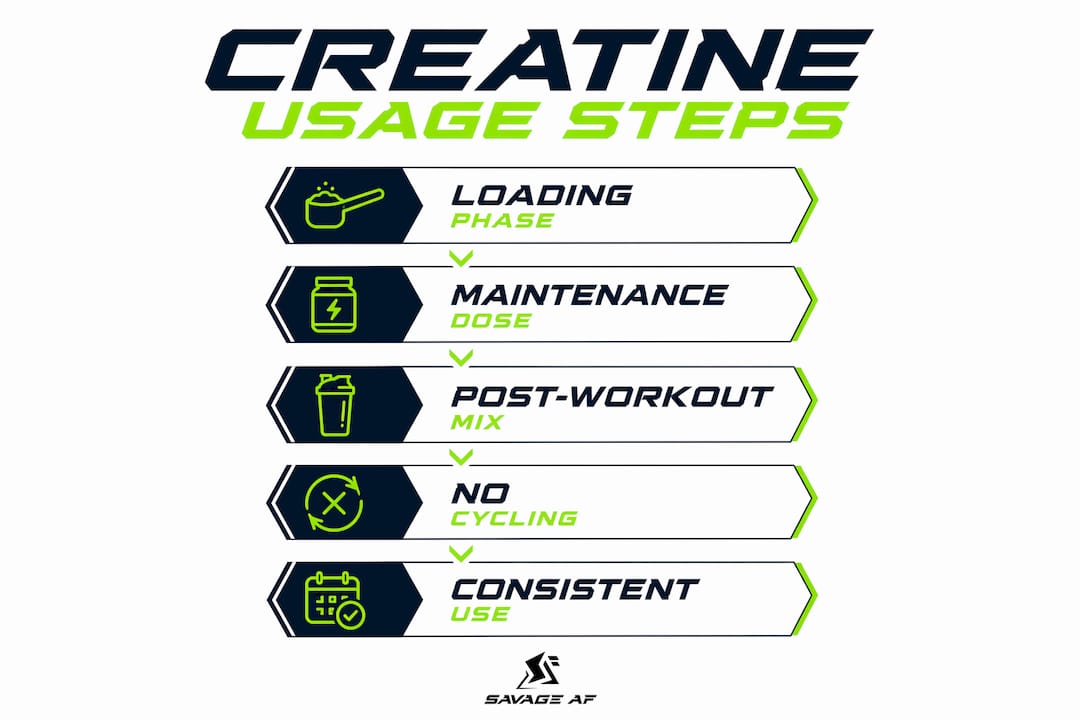
- Loading phase: Take 20 grams per day (split into four 5-gram doses) for 5 to 7 days. This saturates your muscle creatine stores fast, typically within one week. You’ll feel the performance difference quickly.
- Maintenance phase: Drop to 3 to 5 grams per day after loading. This maintains full saturation indefinitely. No cycling needed.
- Skip the load: Take 3 to 5 grams per day from day one without loading. You’ll reach the same saturation level, but it takes approximately 4 weeks instead of one. Same destination, slower road.
- Consistency is non-negotiable: Daily creatine intake maintains muscle saturation best. Missing days chips away at your stores and reduces the benefit over time.
- Timing is flexible: Post-workout with a carbohydrate and protein source shows a slight edge in some studies, but the research confirms that total daily intake matters far more than precise timing.
Pro Tip: Mix your creatine into your post-workout shake with fast-digesting carbs like dextrose or fruit juice. The insulin spike from carbs may improve creatine uptake into muscle cells, squeezing out every last advantage.
Cycling off creatine is unnecessary and counterproductive. The ISSN recommends steady daily dosing without breaks. There is no physiological reason to stop, and stopping only forces you to re-saturate your muscles before you see full benefits again.

Why creatine alone won’t build your strength
Creatine is a training enhancer, not a training replacement. This distinction matters more than most supplement guides admit. Research confirms that creatine’s lean mass and strength benefits depend heavily on pairing with resistance training. Without that stimulus, you’re leaving the majority of creatine’s potential on the table.
Here’s what the data shows when you compare outcomes:
| Condition | Strength Gains | Lean Mass Gains |
|---|---|---|
| Creatine alone (no resistance training) | Minimal | Minimal |
| Resistance training alone | Moderate | Moderate |
| Creatine plus resistance training | Significant | +3.39 kg fat-free mass average |
| Creatine plus high-volume training | Maximum | Highest recorded in RCTs |
The mechanism is straightforward. Creatine increases work capacity per set and improves recovery between sets. More volume at higher intensity creates a stronger neuromuscular adaptation signal. Your muscles grow because you’re forcing them to do more work, and creatine makes that extra work possible. Without the training, there’s no signal to adapt to.
Think of creatine as the fuel that lets you push harder in every session. The gym is still the battlefield. Creatine just makes you a better-armed soldier walking into it.
What are the myths and real side effects of creatine?
Creatine carries more myths than almost any supplement in the industry. Time to kill them.
- Myth: Creatine causes fat gain. False. The early weight gain of 2 to 3 pounds within the first two weeks is water retention inside muscle cells, not fat. This is actually a positive sign that creatine is working.
- Myth: Creatine damages your kidneys. False for healthy adults. A structured review of side effects shows low incidence of adverse events at standard athletic doses of 3 to 5 grams per day, with placebo groups often reporting equal or higher rates of discomfort.
- Myth: You need to cycle creatine. False. Continuous daily use maintains saturation and performance. Cycling is a gym-bro myth with no scientific basis.
- Myth: Creatine is a steroid. Completely false. Creatine is a naturally occurring compound found in red meat and fish. It is legal, widely available, and approved by every major sports organization.
- Fact: Bloating can occur during loading. Some users experience mild GI discomfort when taking 20 grams per day during the loading phase. Splitting doses into four servings throughout the day resolves this for most people.
Pro Tip: If you have pre-existing kidney conditions, consult your doctor before starting creatine. For healthy adults under 35 with no kidney history, the safety profile at recommended doses is excellent.
The water retention you see in the first two weeks is intramuscular, meaning it’s inside the muscle cells, not under the skin. Your muscles look fuller and feel harder. That’s not a side effect. That’s creatine doing its job.
How to choose the best creatine product for your goals
Creatine monohydrate is the gold standard. Full stop. The ISSN’s review of 500-plus studies concludes that creatine monohydrate is the most effective and cost-efficient form available, with no peer-reviewed evidence showing any other variant outperforms it.
| Creatine Form | Effectiveness | Cost | Verdict |
|---|---|---|---|
| Creatine monohydrate | Highest (gold standard) | Low | Best choice |
| Creatine HCl | Similar, less data | High | No proven advantage |
| Buffered creatine (Kre-Alkalyn) | Comparable, less studied | High | Marketing over science |
| Liquid creatine | Lower stability | High | Avoid |
| Creatine ethyl ester | Inferior absorption | Moderate | Skip it |
Monohydrate wins on every metric. It’s the form used in the vast majority of research, it’s stable in powder form, and it costs a fraction of the “advanced” variants. Anyone selling you on HCl or buffered forms as superior is selling marketing, not science.
For synergy, stack creatine monohydrate with a quality pre-workout and BCAAs. Pre-workout drives intensity and focus so you can push harder in every session. BCAAs support muscle protein synthesis and reduce breakdown during training. Creatine handles the energy system. Together, these three cover the full performance spectrum from warm-up to recovery.
Savageaf’s creatine and strength performance lineup is built around pure creatine monohydrate, no fillers, no gimmicks. Take it daily for maximum performance and pair it with your training program for results you can actually measure.
Key takeaways
Creatine monohydrate, dosed at 3 to 5 grams daily and paired with structured resistance training, is the most effective and evidence-backed strategy to increase strength, power, and lean muscle mass.
| Point | Details |
|---|---|
| Creatine monohydrate is the standard | No other creatine form outperforms monohydrate in peer-reviewed research. |
| Loading accelerates saturation | 20 g/day for 5 to 7 days saturates muscles fast; 3 to 5 g/day alone takes about 4 weeks. |
| Training is non-negotiable | Creatine’s lean mass and strength benefits require resistance training to fully activate. |
| Water weight is progress | Early weight gain of 2 to 3 pounds is intramuscular hydration, not fat. |
| Daily consistency beats cycling | Continuous daily dosing maintains saturation; cycling off reduces effectiveness with no benefit. |
Why I stopped overthinking creatine and just committed
By Ronnie Savoie
I spent two years cycling creatine on and off because I’d read some forum post about “receptor downregulation.” That was two years of inconsistent saturation and inconsistent results. The moment I committed to daily monohydrate, no breaks, no loading drama, just 5 grams every morning, my training shifted.
The water weight scared me at first. Three pounds in two weeks felt wrong. Then I looked in the mirror and my muscles looked like they were inflated from the inside. That’s not fat. That’s your muscles holding more water because they’re saturated with creatine. Embrace it.
Here’s the uncomfortable truth most guides skip: creatine doesn’t work if your training is soft. I’ve seen guys take creatine religiously and make zero progress because they’re not pushing hard enough in the gym. Creatine amplifies what you’re already doing. If you’re grinding, it makes you grind harder. If you’re coasting, it makes you coast slightly better. The supplement doesn’t build the warrior. You do. Creatine just makes sure your energy system doesn’t tap out before your will does.
— Ronnie Savoie
Fuel your strength with Savageaf
Savageaf built its creatine line for athletes who don’t accept average. The Max Muscle Pure Creatine Formula delivers pharmaceutical-grade creatine monohydrate with zero filler, zero compromise. For those who want the full arsenal, the Performance Stack bundles creatine, pre-workout, and BCAAs into one aggressive recovery and strength system. This is the stack built for people who train like their life depends on it. Load up, show up, and dominate every session. No excuses. No off days.
FAQ
What is the best daily dose of creatine for strength?
The ISSN recommends 3 to 5 grams of creatine monohydrate per day for maintenance after an optional loading phase of 20 grams per day for 5 to 7 days. This dose maintains full muscle saturation for consistent strength and power output.
Does creatine work without lifting weights?
Creatine improves anaerobic power independently of resistance training, but lean mass and significant strength gains require a structured lifting program. Without resistance training, creatine’s impact on muscle size and strength is minimal.
How long does creatine take to work?
With a loading phase, most users notice performance improvements within 7 days. Without loading, full muscle saturation takes approximately 4 weeks at 3 to 5 grams per day.
Is creatine monohydrate better than creatine HCl?
Creatine monohydrate is the most studied and effective form available. No peer-reviewed evidence shows creatine HCl or any other variant outperforms monohydrate in strength or muscle growth outcomes.
Does creatine cause fat gain?
No. The 2 to 3 pound weight increase in the first two weeks is intramuscular water retention, not fat. This is a sign creatine is saturating your muscle cells and working as intended.


