


Testosterone is the primary anabolic hormone responsible for muscle growth, driving protein synthesis, satellite cell activation, and neuromuscular adaptation in trained athletes. The role of testosterone in muscle growth goes far beyond a simple hormonal boost. It is the biological engine behind hypertrophy, the clinical term for muscle fiber enlargement through resistance training. When testosterone levels are optimized, your body builds lean muscle faster, recovers harder, and trains at a higher volume. When they drop, so does everything else. This guide breaks down the science, the clinical evidence, and the no-excuses strategies to make testosterone work for you.
How does testosterone stimulate muscle growth at the molecular level?
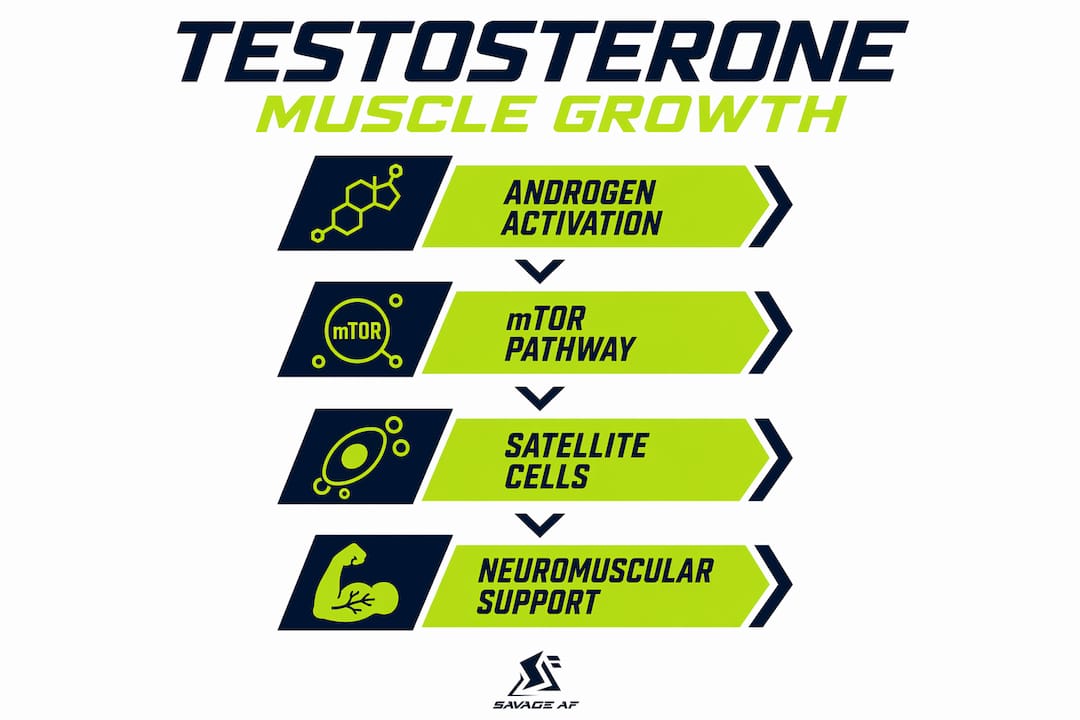
Testosterone triggers muscle growth through three distinct biological pathways. Understanding all three tells you exactly why this hormone is non-negotiable for serious athletes.
Androgen Receptor Activation
Testosterone binds to androgen receptors embedded inside muscle fibers. That binding event switches on genes responsible for protein synthesis and muscle fiber repair. The more androgen receptors you have, and the more testosterone you supply, the stronger that signal becomes.
mTOR Pathway and Protein Synthesis
Once androgen receptors fire, testosterone activates the mTOR pathway, the master regulator of muscle protein synthesis. mTOR acts like a construction foreman. It tells your ribosomes to build new muscle proteins from the amino acids you eat. Without adequate testosterone, mTOR activity drops and muscle protein synthesis slows even when your training and nutrition are dialed.
Satellite Cell Proliferation
Satellite cells are dormant stem cells that live alongside muscle fibers. Heavy training damages those fibers. Testosterone activates satellite cells, pushing them to multiply, differentiate, and fuse into existing muscle fibers. That fusion process is what makes a muscle fiber thicker and stronger over time. No satellite cell activation means no real hypertrophy. Period.
| Pathway | What It Does | Training Trigger |
|---|---|---|
| Androgen Receptor | Switches on muscle-building genes | Resistance training load |
| mTOR Activation | Drives protein synthesis in muscle fibers | Mechanical tension plus nutrition |
| Satellite Cell Activation | Repairs and thickens muscle fibers | Muscle damage from heavy lifts |
Pro Tip: Compound movements like squats, deadlifts, and bench press create the highest mechanical tension, which amplifies androgen receptor sensitivity and makes testosterone’s molecular signals hit harder.
Exogenous testosterone combined with resistance training produces up to 3 times more muscle gain than training alone. That number tells you the synergy between hormonal environment and mechanical stress is not optional. It is the entire game.
What does the clinical research say about testosterone and muscle mass?
The science on testosterone’s effect on muscle is not theoretical. The data from 2026 trials is direct and specific.
Supraphysiological testosterone doses of 600 mg per week increase muscle protein synthesis by 27–35% and add 3–6 kg of lean body mass in just 10 weeks. That is not a marginal gain. That is a structural shift in body composition within a single training block.
Key findings from the clinical evidence:
- Lean mass gains are consistent. Testosterone therapy reliably increases lean body mass across age groups and training backgrounds.
- Strength gains are variable. Lower-body strength improvements are more reliable than upper-body gains, likely because leg muscles carry a higher density of androgen receptors.
- Metabolic adaptations matter. In men 65 and older, testosterone therapy plus lifestyle intervention enhances skeletal muscle glycolysis, improving muscle preservation and aerobic function. That means testosterone does not just build muscle. It keeps the metabolic machinery inside muscle running efficiently.
- Training is non-negotiable. Testosterone replacement therapy amplifies muscle growth only when combined with resistance training. Without it, the hormonal boost delivers limited gains and minimal metabolic benefit.
Testosterone functions primarily as an amplifier that enhances the effectiveness of resistance training and proper protein intake for bodybuilding results. It is not a substitute for the work.
Pro Tip: If you are considering testosterone therapy, get a full hormonal panel first, not just total testosterone. Free testosterone, SHBG, LH, and estradiol all affect how your body actually uses the hormone.
Strength gains often precede visible hypertrophy because improved neuromuscular function lets you train harder before size catches up. That is why your lifts go up before your arms grow. Trust the process.
How does testosterone support neuromuscular function and recovery?
Testosterone’s impact on athletic performance extends well past the muscle fiber itself. It rewires how your nervous system communicates with your muscles.
- Motor unit recruitment improves. Testosterone enhances neuromuscular efficiency and motor unit recruitment, meaning your nervous system fires more muscle fibers simultaneously during a heavy set. More fibers recruited equals more force produced.
- Recovery accelerates. Higher testosterone levels reduce the time your muscles need between sessions. Faster recovery means more training volume per week, and more volume is the primary driver of long-term hypertrophy.
- Catabolic hormones get suppressed. Testosterone counteracts cortisol, the stress hormone that breaks down muscle tissue. When testosterone is high and cortisol is controlled, your body stays in a net anabolic state longer.
- Motivation and drive increase. Testosterone directly influences dopamine signaling. Higher levels translate to more aggression in training, better focus under a loaded bar, and the mental edge to push past failure.
Pro Tip: Track your training intensity and recovery quality alongside your hormonal data. If you are sleeping 8 hours, eating enough protein, and still feeling flat in the gym, a hormonal panel may reveal the real bottleneck. Check out muscle hypertrophy science to understand how these signals connect.
These neuromuscular benefits compound over time. More motor units recruited today means heavier lifts next month, which means greater mechanical tension on the muscle, which means stronger androgen receptor activation. The cycle feeds itself when you stay consistent.
How to naturally optimize testosterone levels for maximum gains
You do not need a prescription to move the needle on testosterone. Lifestyle variables have a direct and measurable impact on your hormonal output.
- Train with compound movements and prioritize legs. Squats, deadlifts, and Romanian deadlifts trigger the largest testosterone response of any exercise category. Leg training specifically drives acute hormonal spikes that benefit your entire body.
- Keep workouts under 60 minutes. High cortisol from overly long workouts blunts testosterone’s anabolic effects. Short, intense sessions preserve the hormonal environment you need to grow.
- Hit your protein targets. Adequate protein intake supports both testosterone production and muscle protein synthesis. Aim for 0.7–1.0 grams per pound of bodyweight daily. Explore top protein sources to build a diet that supports hormonal health.
- Prioritize sleep above everything. The majority of testosterone is produced during deep sleep. Seven to nine hours is not a luxury. It is a training variable.
- Manage stress hard. Chronic psychological stress elevates cortisol, which directly suppresses testosterone. Meditation, cold exposure, and structured deload weeks all help.
- Get tested if progress stalls. Comprehensive hormonal panels beyond testosterone can reveal underlying causes when muscle gain plateaus alongside fatigue and poor recovery. Total testosterone alone does not tell the full story.
Natural testosterone support through high-intensity compound lifts, adequate protein, sleep hygiene, and stress management forms the foundation before any supplementation makes sense. Build the base first.
Key takeaways
Testosterone drives muscle growth by activating the mTOR pathway, stimulating satellite cells, and enhancing neuromuscular efficiency, but its full power only unlocks when combined with hard training and disciplined nutrition.
| Point | Details |
|---|---|
| Testosterone activates mTOR | The mTOR pathway drives protein synthesis; testosterone is its primary hormonal trigger. |
| Lean mass gains are reliable | Clinical trials show 3–6 kg of lean mass added in 10 weeks at supraphysiological doses. |
| Training amplifies the effect | Testosterone replacement therapy produces minimal gains without resistance training. |
| Neuromuscular gains come first | Strength improvements precede visible hypertrophy due to improved motor unit recruitment. |
| Lifestyle controls your baseline | Sleep, short intense workouts, and cortisol management directly determine natural testosterone output. |
Testosterone is a tool, not a shortcut
By Ronnie Savoie
I have watched too many serious gym warriors obsess over testosterone as if it were the entire answer. It is not. It is the most powerful amplifier in your biological toolkit, but it only amplifies what you are already doing. If your training is sloppy, your sleep is garbage, and your diet is inconsistent, elevated testosterone will not save you. It will just accelerate mediocrity.
What I have learned from years of training and working with athletes is that the guys who get the most out of their hormonal environment are the ones who treat every variable with the same intensity. They train hard and short. They eat to build. They sleep like it is their job. Testosterone becomes a force multiplier for those habits.
The obsession with testosterone as a lifestyle drug can also obscure its broader role in restoring libido, energy, and quality of life in men who are genuinely deficient. Not every plateau is a testosterone problem. Sometimes it is a sleep problem, a stress problem, or a nutrition problem wearing a hormonal mask.
My honest advice: earn your hormonal edge. Dial in the basics first. Then, if you still feel flat and your numbers confirm it, explore testosterone support options with real data behind them. No excuses. No shortcuts. Just results.
— Ronnie Savoie
Stack your gains with Savageaf
You know the science. Now back it with the right fuel. Savageaf built the Performance Stack for athletes who refuse to leave gains on the table. It combines a hard-hitting pre-workout, BCAAs for muscle preservation, and creatine for raw strength output into one stack designed to work with your hormonal environment, not against it.

Creatine amplifies the same mechanical tension that drives androgen receptor activation. BCAAs feed the mTOR pathway testosterone switches on. The pre-workout keeps your sessions short, intense, and under that 60-minute cortisol threshold. Every product in the stack is engineered to complement what testosterone does at the molecular level. Train harder, recover faster, and build the body that matches your intensity. Grab the Savage Dominance AF Stack and attack every session with everything you have got.
FAQ
What is the primary role of testosterone in muscle growth?
Testosterone drives muscle growth by activating androgen receptors in muscle fibers, triggering the mTOR pathway for protein synthesis, and stimulating satellite cell proliferation to repair and thicken muscle fibers after training.
Does testosterone therapy build muscle without exercise?
No. Testosterone replacement therapy amplifies muscle growth only when combined with resistance training. Without consistent training, the hormonal boost produces limited lean mass gains and minimal metabolic benefit.
How much lean mass can testosterone add in a training cycle?
Clinical data shows supraphysiological testosterone doses can add 3–6 kg of lean body mass in 10 weeks alongside resistance training, with muscle protein synthesis increasing by 27–35%.
Can you naturally boost testosterone for better muscle gains?
Yes. High-intensity compound lifts, leg training, workouts under 60 minutes, adequate protein intake, 7–9 hours of sleep, and active stress management all raise testosterone naturally without pharmaceutical intervention.
Why do strength gains happen before visible muscle size increases?
Strength improvements precede visible hypertrophy because testosterone first improves neuromuscular efficiency and motor unit recruitment. Your nervous system gets stronger before your muscle fibers visibly grow in size.


