


Pre-workout timing for performance is defined as the strategic window of 20–60 minutes before training when you consume your supplement to maximize energy, strength, and focus during your session. Get this window right and caffeine peaks exactly when you’re grinding through your heaviest sets. Miss it and you’re either still waiting for the hit or crashing before you finish. This guide breaks down the science, the variables, and the exact steps to lock in your timing like a pro.
How pre-workout ingredients affect your timing
Not every ingredient in your tub works on the same clock. Understanding each one changes how you schedule your intake.
Caffeine is the engine of most pre-workouts. Peak caffeine concentration in blood typically hits 45–60 minutes after ingestion. That means if you swallow your scoop 15 minutes before training, you’re leaving serious performance on the table.

Citrulline malate drives nitric oxide production and blood flow. Most formulas dose it for effects within 30–60 minutes, which aligns well with the standard caffeine window. Stack them together and you get a coordinated surge of energy and pump right when your warm-up ends.
Beetroot juice is a different animal entirely. Beetroot juice requires 2–3 hours before exercise to deliver its full nitric oxide and endurance benefits. Endurance athletes who use it need to plan their intake around a meal, not a last-minute scoop.
Beta-alanine and creatine do not work acutely. Beta-alanine requires 2–4 weeks of consistent daily intake before it meaningfully impacts exercise performance. Creatine operates the same way through tissue saturation. Taking either one 30 minutes before a single session does nothing special. Learn more about creatine’s daily use and why consistency beats acute timing every time.
- Caffeine: 30–60 minutes before training
- Citrulline malate: 30–60 minutes before training
- Beetroot juice: 2–3 hours before training
- Beta-alanine: daily use over 2–4 weeks
- Creatine: daily use, timing is irrelevant acutely
Pro Tip: If your pre-workout contains beta-alanine, expect a tingling sensation. The beta-alanine tingle peaks around 30 minutes post-ingestion and is completely harmless. It fades with consistent use or a lower dose.
Does your metabolism change when to take pre-workout?
Your body is not a standard machine. Metabolic rate, age, diet, and workout timing all influence how fast pre-workout ingredients hit your system. Two athletes can take the same formula at the same time and feel completely different effects.
Here is how to personalize your schedule based on your physiology and training style:
- Fast metabolism: Your body burns through compounds quickly. Take your pre-workout 20–30 minutes before training to catch the peak before it fades.
- Slow metabolism: Give ingredients more time to absorb. A longer window of 45–60 minutes before your session delivers better results.
- Explosive power training (lifting, sprinting, HIIT): Shorter timing windows work well. Caffeine’s acute spike aligns with the intensity you need from minute one.
- Endurance training (distance running, cycling, rowing): Explosive power sports favor shorter timing while endurance athletes benefit from a longer lead time to sustain energy across a longer effort.
- Morning sessions: Your caffeine sensitivity is higher after sleep. A smaller dose timed 20–30 minutes out can hit harder than you expect.
- Evening sessions: Timing matters most here. Caffeine taken too late wrecks your recovery. Adjust your intake window or switch formulas entirely.
Age also plays a role. Older athletes often metabolize caffeine more slowly, meaning the 45–60 minute window is safer and more effective. Younger athletes with high caffeine tolerance may need to experiment with both ends of the range to find their sweet spot.
Step-by-step guide to timing your pre-workout right
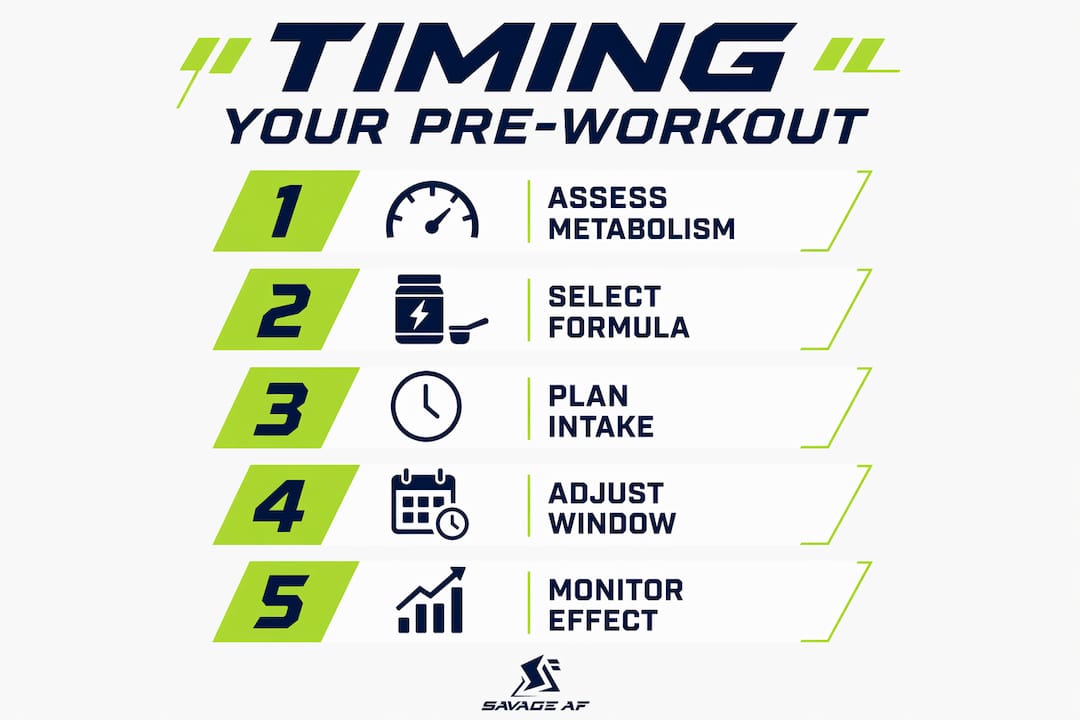
Follow this framework and stop guessing. Precision here is the difference between a session that destroys your PR and one that flatlines at the halfway mark.
The standard timing protocol
| Workout Type | Intake Window | Notes |
|---|---|---|
| Morning strength session | 20–30 min before | Lower caffeine dose; sensitivity is high post-sleep |
| Afternoon HIIT or lifting | 30–45 min before | Standard window; most formulas optimized here |
| Evening endurance training | 45–60 min before | Use stimulant-free formula if training after 5 PM |
| Beetroot juice protocol | 2–3 hours before | Plan around a light meal for endurance events |
Factor in food and other caffeine
Taking pre-workout on a full stomach slows absorption. A light meal 60–90 minutes before your session followed by your supplement 30 minutes out is the sweet spot. Also count your coffee. If you had two cups before noon, your pre-workout caffeine is stacking on top of that. The FDA recommends no more than 400mg total caffeine daily. Blow past that and you get anxiety, jitters, and a crash that kills your recovery.
Pro Tip: Track your total daily caffeine for one week. Most athletes are shocked to find they are already at 250–300mg before they even open their pre-workout tub. Knowing your baseline lets you dose smarter, not harder.
Late workouts: switch your formula
If you train after 6 PM, a stimulant-based pre-workout is a liability. Caffeine-free pre-workouts can be taken at any time without risking sleep disruption. They still deliver pump, endurance, and focus through citrulline, beta-alanine, and adaptogens. You protect your sleep and your next day’s performance at the same time. Read the full breakdown on caffeine’s gym impact to understand when it helps and when it hurts.
What happens when you get the timing wrong?
Timing errors are the most common reason athletes feel like their pre-workout “stopped working.” The formula did not fail. The clock did.
- Taking it too late: You hit peak caffeine 45 minutes into your session. Your warm-up felt flat and your energy spiked right as you were cooling down.
- Taking it too early: Caffeine has already cleared its peak. You feel the crash before your last working set.
- Stacking on top of daily caffeine: Anxiety, heart racing, and a hard crash two hours later. Not performance. Punishment.
- Ignoring the 6-hour rule: A 300mg caffeine dose at 6 PM leaves approximately 150mg still active at midnight. That is enough to destroy your sleep architecture and gut your recovery.
- Expecting creatine and beta-alanine to work acutely: Creatine and beta-alanine require weeks of tissue saturation to improve training outcomes. Single-dose timing is irrelevant for these two.
“The tingling from beta-alanine is not a side effect to fear. It is a signal that the ingredient is active in your system. Adapt to it or reduce your dose. Either way, keep taking it daily.”
Monitor how your body responds over the first two weeks on any new formula. Adjust the timing window by 5–10 minutes at a time until you find the exact moment where energy, focus, and pump all converge at the start of your hardest sets. That is your personal performance window.
Key takeaways
Optimal pre-workout timing for performance requires matching your supplement’s ingredient profile to your metabolism, workout type, and time of day for maximum results.
| Point | Details |
|---|---|
| Core timing window | Take caffeine-based pre-workouts 30–60 minutes before training for peak performance. |
| Ingredient variation matters | Beetroot juice needs 2–3 hours; creatine and beta-alanine require weeks of daily use. |
| Personalize by metabolism | Fast metabolizers dose closer to training; slower metabolizers need a 45–60 minute lead. |
| Protect your sleep | Avoid stimulant pre-workouts within 6 hours of bedtime; use caffeine-free formulas for late sessions. |
| Consistency beats acute timing | Pre-workout benefits accumulate with daily consistent use, not just perfect single-dose timing. |
Timing is a weapon. use it like one.
Here is my honest take after years of training and experimenting with every formula on the market: most athletes obsess over which pre-workout to buy and completely ignore when to take it. That is backwards thinking.
I spent months chasing the “perfect formula” before I realized my timing was the problem. I was taking a full scoop 10 minutes before training because I was always running late. Caffeine was peaking during my drive home, not during my deadlifts. The fix was not a new product. It was a 25-minute shift in my schedule.
The other thing nobody talks about is the cumulative effect. You do not feel the full power of a well-formulated pre-workout on day one. Beta-alanine builds up. Creatine saturates. Even your caffeine sensitivity stabilizes over two weeks of consistent use. The athletes who get the most out of their supplements are the ones who show up every day, not the ones who dose perfectly once a week.
My advice: pick a timing window, stick to it for 14 days, and track your performance honestly. Adjust from there. Stop chasing the magic scoop and start building the habit. That is where the real gains live.
— Ronnie Savoie
Power your sessions with Savageaf
You now know the timing. Now you need the formula that is built to perform inside that window.
Savageaf’s Performance Stack combines pre-workout, BCAA, and creatine into one system engineered for serious athletes who do not cut corners. The pre-workout hits your caffeine and citrulline window hard. The creatine builds the tissue saturation that compounds your strength over weeks. The BCAAs protect your muscle through every brutal set. Whether you train at 5 AM or 10 PM, Savageaf has a formula that fits your schedule. Browse the full performance supplement lineup and build your stack around the timing strategy you just learned. No excuses. Just results.
FAQ
When should i take pre-workout for best results?
Take your pre-workout 30–60 minutes before training to allow caffeine to peak during your session. Faster metabolizers can shorten this to 20–30 minutes.
How long before a workout should i take pre-workout?
The standard window is 30–45 minutes before training for most caffeine-based formulas. Beetroot juice requires 2–3 hours for full nitric oxide benefits.
Can i take pre-workout at night without ruining my sleep?
Avoid caffeine-containing pre-workouts within 6 hours of bedtime. A 300mg dose at 6 PM leaves roughly 150mg active at midnight. Use a stimulant-free formula for evening sessions instead.
Does timing matter for creatine and beta-alanine?
No. Both ingredients work through tissue saturation over 2–4 weeks of daily use. Acute timing of a single dose does not produce meaningful performance benefits for either compound.
What if my pre-workout stops feeling effective?
Check your timing window first. Most athletes find their formula “stopped working” because they shifted their intake time without realizing it. Caffeine tolerance also builds over time, so cycling off for one to two weeks resets your sensitivity.


