


Most athletes know creatine works. Fewer understand why take creatine daily matters more than when you take it. The common assumption is that creatine is a pre-workout tool, something you slam before a session and skip on rest days. That logic sounds reasonable. It’s also wrong. Creatine works through a saturation mechanism, meaning your muscles need to stay loaded with phosphocreatine stores around the clock. Miss days, and you’re slowly draining the tank. This guide breaks down the science, the benefits of daily creatine, and exactly how to make it work for you.
Table of Contents
- Key Takeaways
- How creatine actually works in your body
- The performance benefits are backed hard by science
- Dosing strategy: loading is optional, daily is not
- Is creatine safe to take daily? Here is what research says
- How to integrate daily creatine into your training life
- My take: daily creatine changed how I think about supplementation
- Power your daily protocol with Savageaf
- FAQ
Key Takeaways
| Point | Details |
|---|---|
| Daily intake maintains saturation | Skipping rest days slowly depletes phosphocreatine stores, reducing performance over time. |
| 3 to 5 grams per day is enough | A consistent daily dose reaches full muscle saturation in 3 to 4 weeks without loading. |
| Creatine beats other supplements for strength | A network meta-analysis ranked creatine highest for muscle strength gains among common supplements. |
| It’s safe for healthy adults | Research confirms no meaningful dose-dependent side effects and no impairment of kidney function markers. |
| Consistency beats timing | Taking creatine at the same time daily matters far more than whether it’s before or after training. |
How creatine actually works in your body
Creatine is not a stimulant. It does not spike your heart rate or flood your brain with dopamine. What it does is far more mechanical and, honestly, more powerful for athletes who train hard.
Your muscles store creatine as phosphocreatine. When you fire off a heavy squat, a sprint, or an explosive set of pull-ups, your body burns through ATP (adenosine triphosphate) at a rate your aerobic system cannot keep up with. Phosphocreatine steps in and rapidly donates a phosphate group to regenerate ATP, keeping your muscles firing through those critical seconds of peak output. Creatine supports ATP regeneration during short, intense activity, which is exactly why it translates to strength, power, and muscle gains.
Here is the part most people miss. Your phosphocreatine stores have a ceiling. Once your muscles are fully saturated, you get the full performance benefit. Once they drop below that threshold, you lose it. Muscle saturation explains why daily intake matters regardless of whether you trained that day. Think of it like keeping a phone charged. You do not wait until it dies to plug it in.
Pro Tip: If you are new to creatine, do not obsess over timing. Focus on hitting your daily dose every single day, including weekends and rest days. That consistency is what builds and holds saturation.
The performance benefits are backed hard by science
This is not a supplement with a shaky evidence base. Creatine has decades of research behind it, and the recent data only strengthens the case.
A 2025 network meta-analysis of 35 trials found that creatine ranked highest for strength compared to protein and omega-3 supplementation in trained athletes, with an effect size (SMD) of 0.46. That is not a marginal edge. That is a meaningful, measurable advantage in a population that already trains consistently.
Here is what the benefits of daily creatine actually look like in practice:
- Increased strength output. More phosphocreatine available means more ATP recycled per set, which translates directly to more reps, heavier loads, and greater training volume over time.
- Faster recovery between sets. Your ATP replenishment rate improves, so you recover quicker between heavy efforts. This compounds across a full training session.
- Progressive lean mass accrual. More volume plus better recovery equals more muscle stimulus. Creatine does not build muscle on its own. It lets you train harder, and that training builds the muscle.
- Improved training capacity. You can sustain high-intensity output longer before performance drops, which matters for any sport or session that demands repeated explosive efforts.
The benefits are maximized when you pair creatine with resistance training and adequate protein intake. Creatine without training is like fuel in a parked car. The engine has to run for the gains to show up.
Research note: Body weight may rise early when starting creatine due to water retention in muscle tissue. This is normal and not fat gain. Track your training performance and strength progression instead of the scale.
Dosing strategy: loading is optional, daily is not
The loading phase myth has sent a lot of athletes straight to the bathroom with a cramped stomach and a bad attitude. Here is the truth about daily creatine dosage.

Loading vs. maintenance
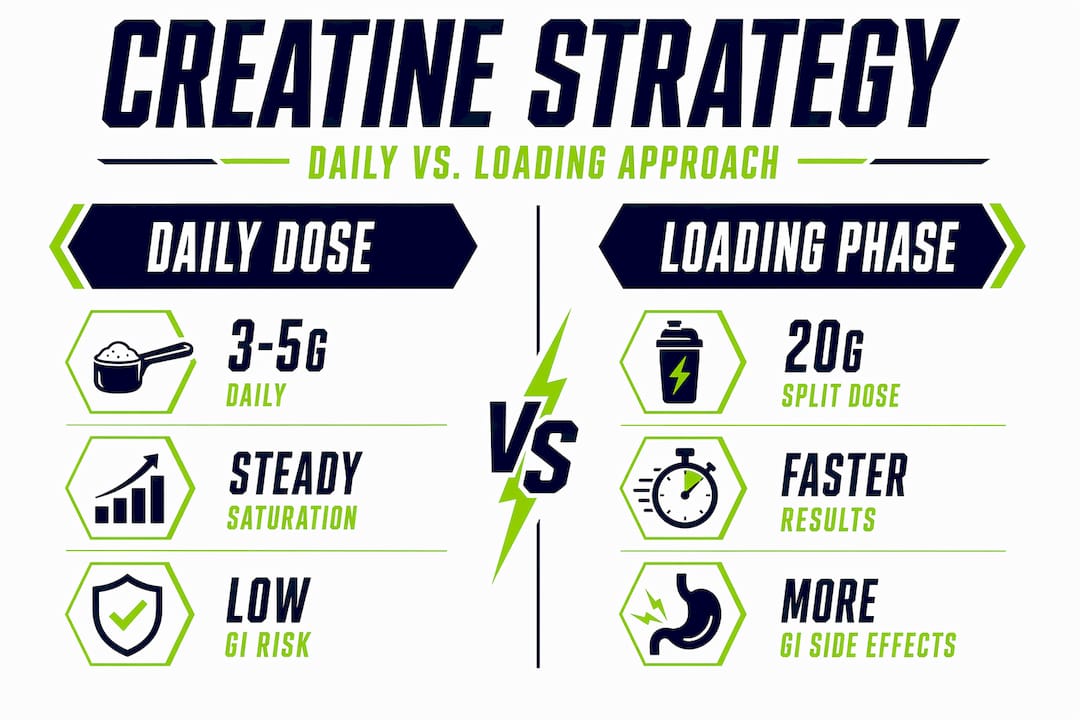
| Approach | Daily Dose | Time to Saturation | GI Risk |
|---|---|---|---|
| Loading phase | 20 g (split into 4 doses) | 5 to 7 days | Higher, especially in sensitive individuals |
| Maintenance only | 3 to 5 g | 3 to 4 weeks | Low |
| Post-loading maintenance | 3 to 5 g | Already saturated | Low |
Loading is optional, not required. If you want faster saturation and can handle the GI load, go for it. If you want a clean, steady ramp-up, 3 to 5 grams daily reaches full muscle saturation in about 3 to 4 weeks with zero drama.
What is never optional is daily consistency. Taking creatine only on workout days reduces your muscle stores over time. You end up in a cycle of partial saturation that blunts the benefits you are working for. Creatine daily advantages only accumulate when the dose is consistent.
Pro Tip: Mix your creatine into your morning coffee, a protein shake, or even water right after you wake up. Tying it to an existing habit removes the mental friction of remembering it on rest days.
Is creatine safe to take daily? Here is what research says
The fear around creatine and kidney health is one of the most persistent myths in sports nutrition. Let’s kill it with data.
A 2026 dose-response analysis found that daily creatine is well tolerated with no consistent dose-dependent increase in side effects compared to placebo across multiple dosing models. That means taking more creatine does not linearly increase your risk of side effects. The safety profile holds up.
The kidney concern specifically comes from a misunderstanding of lab values. Creatine supplementation does raise serum creatinine levels. That sounds alarming until you understand what it means. A systematic review confirmed that serum creatinine rises slightly (about 0.13 mg/dL on average) without any change in eGFR or urea, which are the actual markers of kidney function. Elevated serum creatinine in an athlete taking creatine is a metabolic artifact, not a red flag.
Common concerns addressed directly:
- Kidney damage: No evidence in healthy adults. Elevated serum creatinine is not the same as impaired kidney function.
- Liver stress: Not supported by current research at standard doses.
- Muscle cramps: Often anecdotal and not confirmed in controlled studies.
- GI upset: Real, but almost exclusively linked to high loading doses. Splitting your dose or skipping loading eliminates this for most people.
“People often experience GI upset linked to high-dose loading protocols; splitting doses mitigates this and improves compliance among sensitive users.”
If you have pre-existing kidney conditions, talk to your doctor before supplementing. For healthy athletes, the evidence is clear. Is creatine safe to take daily? Yes. Consistently and confidently.
How to integrate daily creatine into your training life
Knowing the science is one thing. Making it stick is another. Here is a practical framework for getting the most out of daily creatine supplementation.
-
Take it every day without exception. Rest days are not off days for your creatine protocol. Your muscles do not stop needing phosphocreatine replenishment just because you skipped the gym.
-
Pair it with resistance training. Creatine’s performance benefits are tied to how creatine enhances performance during high-intensity training. If you are not lifting or sprinting, you are leaving most of the benefit on the table.
-
Stack it with adequate protein. Creatine supports the training that builds muscle. Protein provides the raw material. Both are non-negotiable if muscle growth is the goal.
-
Handle GI sensitivity by splitting your dose. Take 2.5 grams in the morning and 2.5 grams later in the day if a single 5-gram dose bothers your stomach. This works just as well and keeps you consistent.
-
Measure progress through training performance. Track your working weights, rep counts, and session volume week over week. Long-term strength progression is the real signal that your creatine protocol is working, not a number on the scale.
-
Give it time. Performance gains from creatine emerge over weeks, not days. Full saturation without loading takes 3 to 4 weeks. Commit to the process before judging the results.
Pro Tip: Log your lifts from week one. When you look back after 6 to 8 weeks of daily creatine, the progression in your training numbers will be the clearest proof that it is working. Feelings are unreliable. Data is not.
For additional support on the recovery side of your training, the RECOVER protocol from KAL Wellness Institute offers a healthcare-backed perspective on creatine’s role in athletic performance and recovery.
My take: daily creatine changed how I think about supplementation
I spent years treating creatine like a pre-workout add-on. Training day? Creatine. Rest day? Skip it. I thought I was being efficient. What I was actually doing was sabotaging my own saturation and wondering why the results felt inconsistent.
The shift happened when I stopped thinking about creatine as a performance trigger and started treating it like a daily maintenance protocol. The same way you do not skip sleep on rest days, you do not skip creatine. Once I locked in daily consistency, the strength progression became noticeably more linear. Less plateau, more grind.
What I have also learned is that creatine’s underrated benefit is not the strength spike. It is the recovery. More ATP availability between sets means you can push harder in the back half of a session when most athletes are already running on fumes. That compounding effect across weeks of training is where the real gains live.
One thing I will not let slide: creatine is not a substitute for training hard and eating right. I have seen athletes load up on supplements and coast on effort. Creatine rewards the grind. It does not replace it. If your training and nutrition are dialed in, daily creatine is one of the highest-return additions you can make. If they are not, fix those first.
— Ronnie Savoie
Power your daily protocol with Savageaf

You know why daily creatine works. Now get your hands on a form you will actually take every single day. Savageaf built their creatine lineup for athletes who do not cut corners. The Max Muscle pure creatine formula delivers clean, clinical-grade creatine monohydrate with zero fillers. If you want something that travels with you and hits without a shaker bottle, the Beast Bites creatine gummies make daily dosing dead simple. Chew, grind, dominate. Browse the full performance supplement lineup and build a stack that matches your intensity.
FAQ
Why should you take creatine on rest days?
Your muscles continuously use and deplete phosphocreatine stores even without training. Taking creatine daily maintains full muscle saturation so you are ready to perform at maximum output every session.
What is the best daily creatine dosage?
A dose of 3 to 5 grams per day is clinically effective for most healthy athletes. This amount reaches full muscle saturation in approximately 3 to 4 weeks without a loading phase.
Does daily creatine damage your kidneys?
No. Research shows that creatine raises serum creatinine levels slightly but does not impair eGFR or urea, which are the actual measures of kidney function in healthy adults.
How long before you notice benefits from daily creatine?
Performance gains typically emerge after 3 to 4 weeks of consistent daily use, which is when muscle phosphocreatine stores reach full saturation. Track your training weights and rep counts, not just body weight.
Is it better to take creatine before or after training?
Timing matters far less than daily consistency. Whether you take creatine before, after, or completely separate from your workout, what drives results is maintaining saturation through uninterrupted daily intake.


