


You slam your pre-workout, lace up, and two minutes later your face feels like it’s crawling with fire ants. Your ears buzz. Your forearms prickle. And you’re standing there wondering if you just poisoned yourself or if this is normal. Understanding why pre-workout tingles happen is the difference between panicking and owning that sensation like the weapon it actually is. The short answer: you’re fine. The full answer is way more interesting than that.
Table of Contents
- Key takeaways
- Why pre-workout tingles happen: beta-alanine and paresthesia
- The niacin flush: a second wave of sensation
- Other factors that turn up the volume
- Normal tingling vs. something that needs attention
- Managing and minimizing the tingle
- My take on the tingle
- Power your training with Savageaf
- FAQ
Key takeaways
| Point | Details |
|---|---|
| Beta-alanine is the main culprit | It activates sensory receptors in your skin, producing a harmless tingling called paresthesia. |
| Niacin adds a flush on top | Vasodilation from niacin causes warmth, redness, and tingling through prostaglandin release. |
| Tingling is not an allergic reaction | It’s a neurological response with no histamine involvement and no danger to your health. |
| Dose and formulation control intensity | Splitting doses or choosing slow-release formulas significantly reduces how strong the sensation feels. |
| Know when to act | Hives, swelling, or breathing difficulty are not normal tingling. Those require immediate attention. |
Why pre-workout tingles happen: beta-alanine and paresthesia
The main reason pre-workout tingling explained in almost every sports science paper comes back to one ingredient: beta-alanine. It’s in nearly every performance formula on the market, and for good reason. Beta-alanine buffers lactic acid in muscle tissue, helping you push harder for longer. But it comes with a side effect that catches first-timers completely off guard.
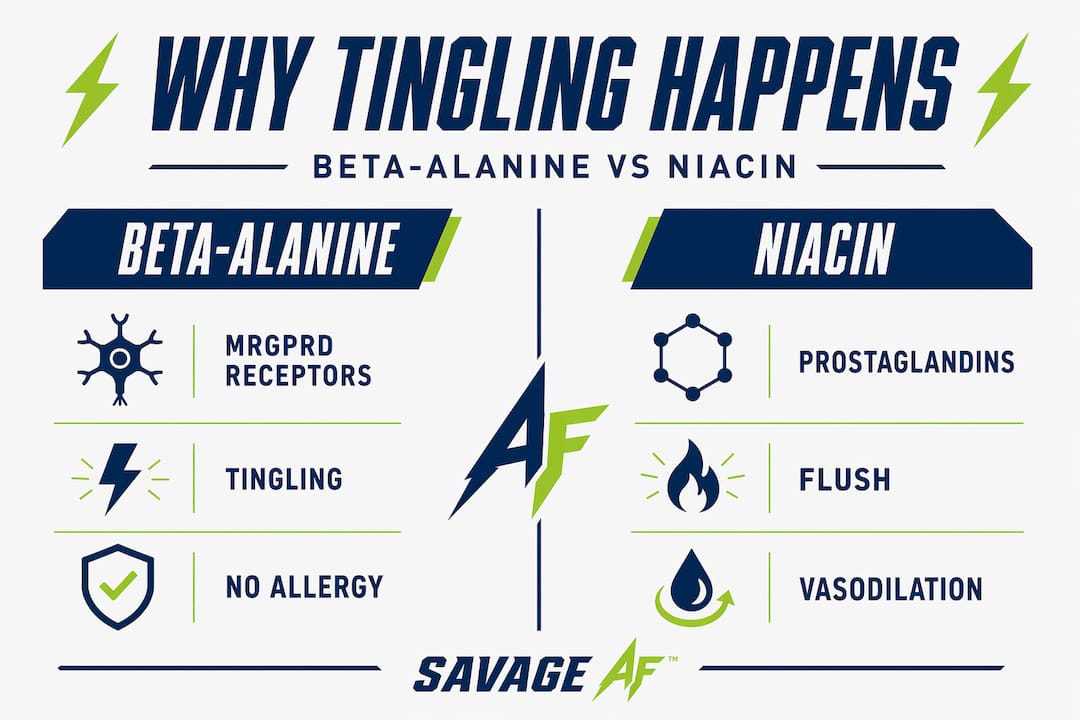
When beta-alanine hits your bloodstream, it activates MRGPRD receptors on the cutaneous sensory neurons sitting just beneath your skin. These are the same nerve endings responsible for detecting touch and temperature. The activation produces what scientists call paresthesia, a prickling, tingling, or itching sensation that has nothing to do with allergies, toxins, or anything going wrong.
Here’s what makes this fascinating: the tingling mechanism is nonhistaminergic. That means antihistamines won’t stop it. No Benadryl is going to save you. The pathway is purely neurological, not immune-mediated. Your body isn’t reacting to a threat. It’s reacting to a pharmacological signal.
The timeline is predictable. Tingling starts 10 to 20 minutes after ingestion and typically fades within an hour. The intensity tracks directly with how much beta-alanine you took and how fast it entered your bloodstream. Take a large dose all at once and the peak serum concentration spikes hard. That spike is what lights up your skin.
Key facts about beta-alanine paresthesia:
- Onset is 10 to 20 minutes post-ingestion, duration up to 60 minutes
- Most intense on the face, ears, neck, and hands
- Completely harmless and not a sign of allergy or toxicity
- Dose-dependent: more beta-alanine equals stronger tingling
- Tolerance builds over time with consistent use
Pro Tip: If you’re new to beta-alanine, start with half a serving for the first week. Your receptors desensitize with repeated exposure, and within two weeks most users report significantly reduced tingling at the same dose.
The niacin flush: a second wave of sensation
Beta-alanine isn’t the only ingredient driving pre-workout side effects. Niacin, also known as vitamin B3, shows up in a lot of pre-workout formulas for its role in energy metabolism and blood flow. It also causes its own distinct sensory reaction called niacin flush syndrome.

The mechanism here is different from beta-alanine. Niacin triggers the release of prostaglandins, signaling molecules that cause blood vessels near the skin surface to dilate rapidly. That vasodilation activates nerve endings in the skin, producing warmth, redness, and a tingling or itching sensation that spreads across the chest, face, and arms.
The niacin flush occurs 15 to 30 minutes after intake and can last anywhere from a few minutes to over an hour depending on dose and formulation. Unlike beta-alanine tingling, niacin flush often comes with visible redness and a warm, almost sunburn-like feeling on the skin.
Here’s a quick breakdown of how the two sensations compare:
| Feature | Beta-alanine tingling | Niacin flush |
|---|---|---|
| Primary mechanism | MRGPRD receptor activation | Prostaglandin-driven vasodilation |
| Onset | 10 to 20 minutes | 15 to 30 minutes |
| Visible redness | Rare | Common |
| Warmth sensation | Mild | Pronounced |
| Antihistamine effective | No | Partially (aspirin more effective) |
| Duration | Up to 60 minutes | Minutes to over an hour |
When both ingredients are in the same formula, which is common in high-stimulant pre-workouts, the effects can stack. You get the prickling from beta-alanine layered on top of the warmth and redness from niacin. That combination is what makes some people think something is seriously wrong.
Pro Tip: Taking a regular-dose aspirin about 30 minutes before your pre-workout can blunt niacin flush by blocking prostaglandin synthesis. It won’t stop beta-alanine tingling, but it takes the edge off the flush component.
Other factors that turn up the volume
Beta-alanine and niacin are the two main causes of workout tingles, but they don’t operate in a vacuum. Several other factors influence how intense the sensation gets for any individual on any given day.
Caffeine and stimulants in pre-workouts can amplify skin sensitivity and indirectly intensify tingling. Caffeine increases blood flow and can contribute to mild dehydration, both of which make your sensory nerves more reactive. If you’re already running low on water, that prickling sensation hits harder.
Individual sensitivity varies significantly based on genetics, skin type, and prior exposure history. Some people barely notice beta-alanine at clinical doses. Others feel like they’re being electrocuted after half a scoop. Concurrent consumption of alcohol or hot beverages before your pre-workout also modulates response severity, typically making it worse.
Formulation type matters more than most people realize. Immediate-release supplements drive a sharp spike in blood concentration, which triggers a stronger and faster tingling response. Slow-release or time-release versions of both beta-alanine and niacin smooth out that curve, reducing the peak and therefore reducing the intensity of what you feel.
Other variables worth knowing:
- Higher total dose per serving equals more intense tingling, every time
- Taking pre-workout on an empty stomach accelerates absorption and increases peak concentration
- Skin that’s already warm or flushed from heat will respond more intensely
- Users with naturally higher metabolic rates may clear the compounds faster, shortening duration
- Stacking multiple pre-workout products without checking combined ingredient totals can push doses into uncomfortable territory
Normal tingling vs. something that needs attention
Here’s where it gets serious. Most of what you feel after taking a pre-workout is completely normal. But not every unusual sensation is pre-workout tingling explained away by beta-alanine. Knowing the difference protects you.
Signs that what you’re experiencing is standard pre-workout paresthesia or niacin flush:
- Tingling starts within 10 to 30 minutes of taking the supplement
- Sensation is symmetrical, spreading across the face, neck, arms, or chest
- No visible hives or raised welts on the skin
- No swelling around the lips, tongue, or throat
- No difficulty breathing or tightness in the chest
- Sensation fades on its own within an hour without intervention
If your experience matches that list, you’re in normal territory. The sensations are temporary neurological effects with no lasting impact on your health. They will pass.
What you should not ignore:
- Hives or raised, itchy welts spreading across the body
- Swelling of the face, lips, or throat
- Difficulty breathing or a feeling of throat tightness
- Prolonged itching that continues well past the one-hour mark
- Nausea, dizziness, or a rapid irregular heartbeat alongside tingling
Those symptoms are not pre-workout tingling. That’s an allergic or adverse reaction, and you need to stop using the product and see a doctor. Read your ingredient labels. If you have known sensitivities to any amino acids, B vitamins, or stimulants, cross-reference before you scoop.
Pro Tip: Always do a half-dose test with any new pre-workout formula before going full serving. This lets you gauge your personal response to the specific ingredient profile without overwhelming your system on day one.
Managing and minimizing the tingle
You don’t have to white-knuckle through intense tingling every session. There are real, practical ways to control it without sacrificing performance.
- Choose formulas with lower beta-alanine content, typically under 2 grams per serving, if you’re highly sensitive
- Split your daily dose across two smaller servings rather than one large pre-workout hit
- Opt for no-stim pre-workout options that use time-release beta-alanine or exclude niacin entirely
- Take your pre-workout with food rather than on an empty stomach to slow absorption and lower peak concentration
- Stay well-hydrated before and during your session to reduce caffeine-amplified skin sensitivity
- Give your body two to three weeks of consistent use before judging tolerance. Desensitization is real and it works
The goal is to split doses strategically so you’re still hitting your total daily beta-alanine target for performance benefits while keeping the peak serum level low enough to avoid the worst of the tingling.
My take on the tingle
I’ve seen it happen dozens of times. Someone tries a pre-workout for the first time, feels their skin light up like a pinball machine, and immediately assumes they’re having an allergic reaction. They dump the product, swear off pre-workouts, and miss out on real performance gains because nobody told them what was actually happening.
In my experience, the tingling isn’t a warning sign. It’s a receipt. It’s your body confirming that the beta-alanine just hit your bloodstream and is on its way to your muscles. Once I understood that, I stopped fighting the sensation and started treating it as a signal that the formula was working.
What I’ve learned is that the athletes who struggle most with tingles are the ones who never read the ingredient panel. They grab whatever’s on sale, slam a full scoop, and wonder why they feel like they’re being tasered. The ones who thrive are the ones who know their dose, know their ingredients, and choose formulas that match their sensitivity level.
The tingle is not your enemy. It’s information. Use it. Adjust your dose, try a slow-release formula, or build tolerance over a few weeks. But don’t quit. The performance benefits of beta-alanine are well-documented, and abandoning them because of a temporary skin sensation is leaving real gains on the table.
New users: be patient. Your receptors will adapt. Give it two to three weeks of consistent use and the tingling will quiet down significantly. Your muscles won’t.
— Savage
Power your training with Savageaf
If the tingle has been holding you back from going all-in on pre-workouts, Savageaf has you covered. The full performance supplement lineup includes options built for every sensitivity level, from high-stim formulas for seasoned athletes to no-stim pre-workouts designed to deliver serious pumps and focus without the face-crawling sensation. Every product comes with full ingredient transparency so you know exactly what you’re putting in your body and exactly why you feel what you feel. No mystery blends. No excuses. Just performance. Explore the range, find your formula, and get back to training like you mean it.
FAQ
What causes pre-workout tingling?
Pre-workout tingling is primarily caused by beta-alanine activating MRGPRD receptors on skin sensory neurons, producing a harmless sensation called paresthesia. Niacin in the formula can add a flushing effect through vasodilation and prostaglandin release.
Is tingling from pre-workout normal?
Yes. Tingling from pre-workout is a normal, temporary neurological response with no allergic or toxic component. It typically begins 10 to 20 minutes after ingestion and fades within an hour.
How do you reduce pre-workout tingles?
Splitting your dose into smaller servings, choosing slow-release formulations, taking pre-workout with food, and opting for no-stim or lower beta-alanine products are the most effective ways to reduce pre-workout tingles.
Why do pre-workout tingles occur on the face and ears?
The face and ears have a high density of cutaneous sensory neurons, making them more responsive to beta-alanine-induced MRGPRD receptor activation. That’s why those areas typically feel the tingling most intensely.
When should I be concerned about pre-workout tingling?
Stop using the product and consult a doctor if you experience hives, swelling, throat tightness, or difficulty breathing alongside tingling. These are signs of an allergic reaction, not normal paresthesia.


