


You think muscle growth is just about slapping more plates on the bar. Wrong. Understanding what is muscle hypertrophy at a biological level is what separates the guys who actually build slabs of muscle from the guys who spin their wheels for years going nowhere. Hypertrophy, the scientific term for increasing muscle size through fiber growth, is a precise physiological process driven by training stimulus, nutrition, and recovery working together. This guide breaks down the science, the training principles, the fuel, and the tracking methods you need to build real, undeniable size.
Table of Contents
- Key Takeaways
- What is muscle hypertrophy: the biology behind bigger muscles
- Training principles to achieve muscle hypertrophy
- Nutrition and recovery for muscle growth
- Recognizing the signs of muscle hypertrophy
- My honest take on hypertrophy myths
- Fuel your hypertrophy with Savageaf
- FAQ
Key Takeaways
| Point | Details |
|---|---|
| Hypertrophy is fiber thickening | Muscles grow bigger through fiber enlargement, not by producing more fibers. |
| Volume drives growth | Training volume has a dose-response relationship with hypertrophy, so more smart sets equal more size. |
| Nutrition is non-negotiable | Protein intake and caloric surplus directly control whether muscle protein synthesis wins the battle. |
| Recovery is where growth happens | Sleep and rest trigger the cellular repair that physically builds larger muscle fibers. |
| Track more than scale weight | Use measurements, mirror checks, and performance data together to confirm real hypertrophy progress. |
What is muscle hypertrophy: the biology behind bigger muscles
Muscle hypertrophy is the increase in muscle size through thickening and enlargement of individual muscle fibers. Your body does not manufacture new fibers when you train hard. It makes existing ones bigger, denser, and more capable. That distinction matters because it shapes every training decision you make.
Here is what actually happens inside your muscle when you lift:
- Mechanical tension from loaded contractions triggers anabolic signaling cascades, most critically the mTORC1 pathway, which acts as the master switch for muscle protein synthesis.
- Muscle protein synthesis vs. breakdown is the battleground. Hypertrophy occurs when synthesis consistently exceeds breakdown over time. Training and nutrition control which side wins.
- Satellite cells are dormant stem cells surrounding muscle fibers. Training wakes them up, and they donate nuclei to muscle fibers to support repair and growth. More myonuclei mean more machinery for protein production and bigger fibers.
- Repeated training sessions accumulate the molecular and cellular growth signals that translate into real size gains over weeks of consistent work.
This process is slow, deliberate, and deeply systemic. One brutal workout does not build muscle. A sustained assault of progressive training, feeding, and recovery does.
Muscle hypertrophy vs strength: not the same thing

This is where most gym warriors get confused. Strength gains in the early weeks of training come almost entirely from neuromuscular adaptation. Your nervous system learns to recruit motor units more efficiently. No new muscle tissue required. That is why beginners get dramatically stronger before they visibly grow.
True hypertrophy requires structural change inside the fiber itself, and training variables differ significantly between size and pure strength goals. Strength training uses heavier loads, lower rep ranges (typically 1 to 5 reps), and longer rest periods. Hypertrophy training uses moderate loads, higher rep ranges (typically 6 to 20 reps), and shorter rest windows. Both build size to some degree, but the emphasis is different.
Pro Tip: If your strength is climbing but your measurements are not changing, you may be in pure neural adaptation territory. Add higher-rep sets and shorter rest periods to force the structural muscle changes that actually build size.
Training principles to achieve muscle hypertrophy
Knowing the biology is step one. Translating it into a program that actually works is where most people fail. Here are the principles that evidence-based hypertrophy training is built on:
- Progressive overload. You must continually challenge the muscle with increasing demands. That means more weight, more reps, more sets, or less rest over time. Stagnation is the enemy of growth.
- Training volume as the primary driver. Weekly volume (total sets per muscle group) has a positive dose-response relationship with hypertrophy. More sets generally produce more growth, up to a point. Most intermediate lifters are under-dosing their volume relative to what they can recover from.
- Rep range. Work predominantly in the 6 to 20 rep range. This is where metabolic stress and mechanical tension combine to hit hypertrophy hard. Do not ignore heavy sets either. Heavy compound work in the 4 to 6 rep range contributes to size when volume is sufficient.
- Rest intervals. Keep rest periods between 60 and 120 seconds for isolation work and 2 to 3 minutes for compound movements. Shorter rests amplify metabolic stress. Longer rests allow heavier loading. Both matter.
- Proximity to failure. Stop sets within 1 to 3 reps of failure. Research confirms that effort intensity matters as much as load. Leaving 8 reps in the tank on every set means you are not creating the stimulus needed for growth.
- Exercise selection. Prioritize compound movements for volume and mechanical tension. Add isolation work to target specific muscles you want to grow. Variety keeps motor unit recruitment fresh.
Common training mistakes that kill hypertrophy
Going too heavy too often is one of the biggest killers of muscle growth. Ego lifting destroys form, reduces range of motion, and shifts tension away from the target muscle. The muscle does not know the weight on the bar. It only knows tension.
Skipping deload weeks is the other one. Your body adapts to training stress during recovery, not during the workout. Without planned lighter weeks, accumulated fatigue masks your fitness gains and stalls your growth.
Pro Tip: Track your reps in reserve (RIR) on every set, not just the weight. If you consistently finish sets with more than 3 reps left in the tank, you are not creating enough stimulus for growth regardless of how heavy the bar is.
Nutrition and recovery for muscle growth
You can train like an animal and still leave size on the table if your nutrition and recovery are garbage. Here is what your body actually needs to build muscle:
- Protein intake. Aim for 0.7 to 1 gram of protein per pound of bodyweight daily. Protein synthesis requires adequate amino acid availability, especially leucine, the primary trigger for mTORC1 activation. Understanding protein shake timing can further sharpen your muscle-building results.
- Caloric surplus. You cannot build new tissue from nothing. A modest surplus of 250 to 500 calories above maintenance creates the anabolic environment your muscles need to grow without burying them in fat.
- Carbohydrates. Carbs refuel glycogen stores, power your training sessions, and spike insulin to support a protein-sparing anabolic state. Do not fear them.
- Hydration. Dehydration impairs contractile force, blunts recovery, and disrupts the hormonal responses that trigger cellular repair. Drink water like your gains depend on it, because they do.
- Sleep. Growth hormone peaks during deep sleep. This is when satellite cells activate, proteins rebuild, and the structural changes from training actually take hold. Seven to nine hours is not optional. It is the protocol.
- Supplements. Whey protein and creatine are the two most research-backed tools for supporting hypertrophy. Creatine increases phosphocreatine availability for more explosive reps and has documented effects on lean muscle accumulation. Taking creatine daily keeps your muscles saturated so every training session hits harder.
Recovery is not passive. It is an active biological process. Treat it with the same intensity you bring to your training.
Recognizing the signs of muscle hypertrophy
You need to know if your program is actually working. Feeling sore does not mean you are growing. Here is how to identify real hypertrophy progress:
Muscle fullness and thickness are your first physical indicators. Your shirts get tighter in the shoulders and arms. Your quads push against your pants. These are real structural changes, not pump illusions from a single workout.
Performance shifts also signal growth. You are lifting heavier with control, executing cleaner reps at heavier loads over time. The pump you achieve during training intensifies as capillary density and muscle volume increase.
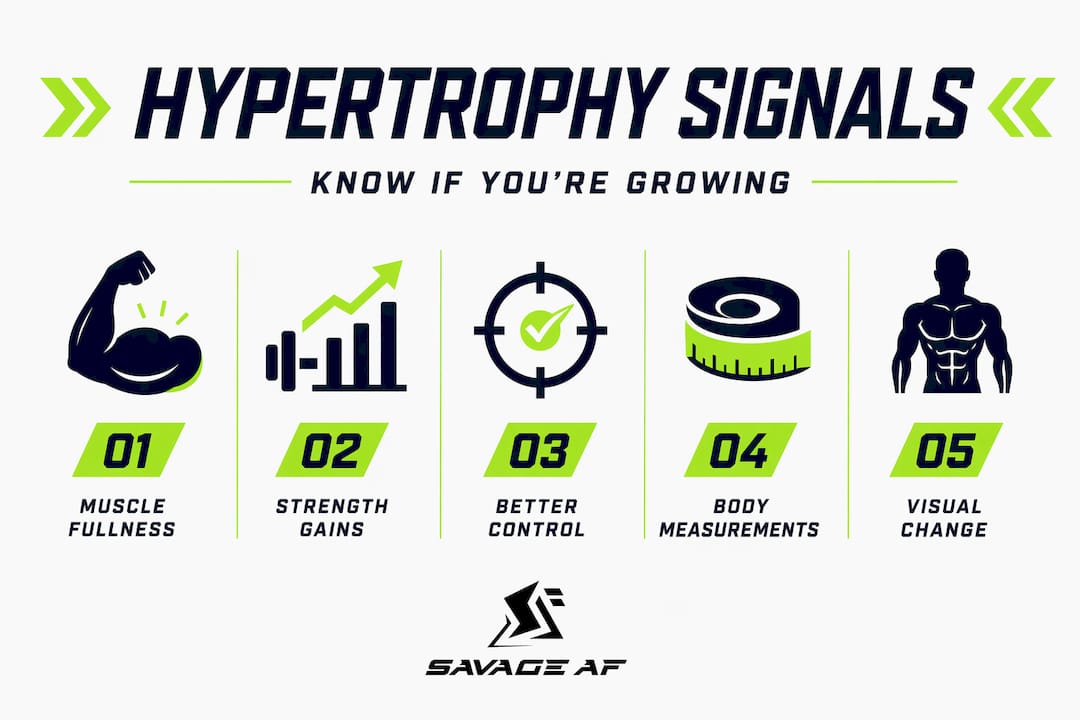
Body measurements are your most reliable objective tool. Track arm, chest, thigh, and shoulder circumference every two to four weeks. The scale alone lies. You could gain muscle and lose fat simultaneously, showing no net weight change, while your body composition transforms completely.
Avoid confusing early strength jumps with hypertrophy. As noted earlier, neuromuscular adaptation drives most early strength gains without meaningful size increases. Real hypertrophy builds over months of consistent, properly dosed training, not weeks.
Pro Tip: Take monthly progress photos in identical lighting and poses. Visual changes are often dramatic over 8 to 12 weeks but invisible week to week. Photographs catch what your distorted daily mirror perception misses.
My honest take on hypertrophy myths
I have watched too many serious lifters wreck their potential by chasing one-rep maxes every single session. In my experience, the biggest myth in the gym is that more weight automatically means more muscle. It does not. More accumulated tension on the target muscle over properly managed volume is what builds size.
What I have seen work, consistently, is a disciplined commitment to volume management. The research on volume dose-response confirms what experienced coaches have known for years. Most intermediate lifters are under-training in terms of total sets, not under-loading in terms of weight on the bar. Add two sets per week per muscle group every few weeks and track what happens.
The other truth nobody wants to hear? Recovery neglect is the silent killer of hypertrophy. I have seen athletes doing everything right in the gym and eating perfectly but sleeping five hours a night and wondering why they are not growing. That is not a training problem. That is a lifestyle problem. If you are serious about size, you protect your sleep like you protect your training sessions.
Chase volume. Earn your recovery. Repeat relentlessly.
— Ronnie Savoie
Fuel your hypertrophy with Savageaf
You know the science. Now you need the weapons.

Savageaf builds supplements for people who are not playing games with their training. Stack the Impact Whey Protein Isolate for fast-absorbing muscle repair post-workout, and hit your creatine daily with Beast Bites Creatine Gummies because nobody said fueling muscle growth had to be boring. The full lineup of performance supplements covers everything from pre-workout intensity to recovery support. No fluff. No filler. Just the raw fuel your hypertrophy demands. Build brutal. Go Savage.
FAQ
What is the definition of muscle hypertrophy?
Muscle hypertrophy is the increase in muscle size caused by the thickening and enlargement of individual muscle fibers, driven by resistance training, adequate protein intake, and recovery.
How long does it take to see muscle hypertrophy results?
Visible hypertrophy typically takes 8 to 12 weeks of consistent training and proper nutrition, though early strength gains in the first few weeks are mostly neural adaptations rather than structural muscle growth.
What rep range is best for muscle hypertrophy?
The 6 to 20 rep range is considered optimal for hypertrophy because it maximizes both mechanical tension and metabolic stress. Heavy compound work in the 4 to 6 rep range also contributes when total volume is sufficient.
How does muscle hypertrophy differ from strength gains?
Strength gains can occur through improved neuromuscular efficiency without size increases, while hypertrophy specifically requires structural changes inside muscle fibers through sustained training volume and anabolic signaling.
What supplements support muscle hypertrophy most effectively?
Whey protein and creatine are the most research-supported supplements for hypertrophy. Protein supplies the amino acids needed for synthesis, and creatine increases training capacity and supports lean muscle accumulation over time.


