


Most athletes think caffeine just wakes them up. That’s wrong. Understanding why caffeine boosts workout performance requires a hard look at how it rewires your brain and muscles to push past limits you thought were fixed. This isn’t about swapping sleep for espresso shots. The scientific term is ergogenic aid, and caffeine is the most studied one in sports science. It works through adenosine receptor blockade, central nervous system excitability, and altered pain perception. By the end of this breakdown, you’ll know exactly what’s happening inside your body and how to weaponize it.
Table of Contents
- Key Takeaways
- Why caffeine boosts workout performance at the brain and muscle level
- Evidence-based benefits across different workout types
- Nuances, limitations, and potential downsides
- Practical guidelines for using caffeine before workouts
- My honest take after years in the trenches
- Savage AF gear to take your training further
- FAQ
Key Takeaways
| Point | Details |
|---|---|
| Caffeine rewires fatigue signals | It blocks adenosine receptors in the brain, reducing perceived effort and pain during hard training. |
| Performance gains are real and measurable | Meta-analyses confirm reduced cycling time and increased power output with doses as low as 3 mg/kg. |
| High doses can stall muscle growth | Continuous high caffeine exposure reduces muscle protein synthesis, making strategic cycling critical. |
| Timing and dose matter | Take 3 to 6 mg/kg body weight roughly 45 to 60 minutes before training for peak effect. |
| Individual response varies | Age, sex, training status, and habitual caffeine use all affect how much you benefit. |
Why caffeine boosts workout performance at the brain and muscle level
Here’s the thing most people get wrong: caffeine doesn’t create energy. What it actually does is block the brain’s fatigue signals, and that distinction changes everything about how you use it.
Caffeine is a non-selective adenosine antagonist. Adenosine is a neurotransmitter that builds up during exercise and makes your brain feel tired. Caffeine plugs into those same receptors without activating them, essentially jamming the signal. The result is a brain that doesn’t know it’s supposed to slow down yet.
When adenosine is blocked, your central nervous system runs hotter. Dopamine, norepinephrine, and acetylcholine all spike. Your neurons fire faster. Motor unit recruitment improves, meaning more muscle fibers get activated per contraction. Stronger signal. Harder contractions. More output. Research confirms that EMG amplitude increases significantly under caffeine, which is objective proof that your muscles are receiving more aggressive signals from your nervous system.
The pain reduction piece is equally critical. Caffeine lowers your rating of perceived exertion (RPE) during high-intensity work. You’re not weaker or less damaged after a hard set. You just feel it less. That gap between actual effort and perceived effort is where caffeine earns its reputation as the legal edge serious athletes respect.
- Adenosine receptor blockade reduces central fatigue before it accumulates
- Increased neurotransmitter release (dopamine, norepinephrine) amplifies focus and aggression in training
- Enhanced motor unit recruitment drives more muscle fiber activation per rep
- Lower RPE and pain perception lets you push through thresholds you’d normally retreat from
- Improved neuromuscular signaling sustains output later in a session when fatigue typically kills performance
Pro Tip: Morning training sessions see the biggest gains from caffeine because adenosine levels are already elevated after sleep. Research showed that 6 mg/kg of caffeine restored morning neuromuscular output to evening performance levels in trained females.
Evidence-based benefits across different workout types
The research on caffeine and exercise isn’t thin. It’s stacked. And the numbers are hard to ignore.
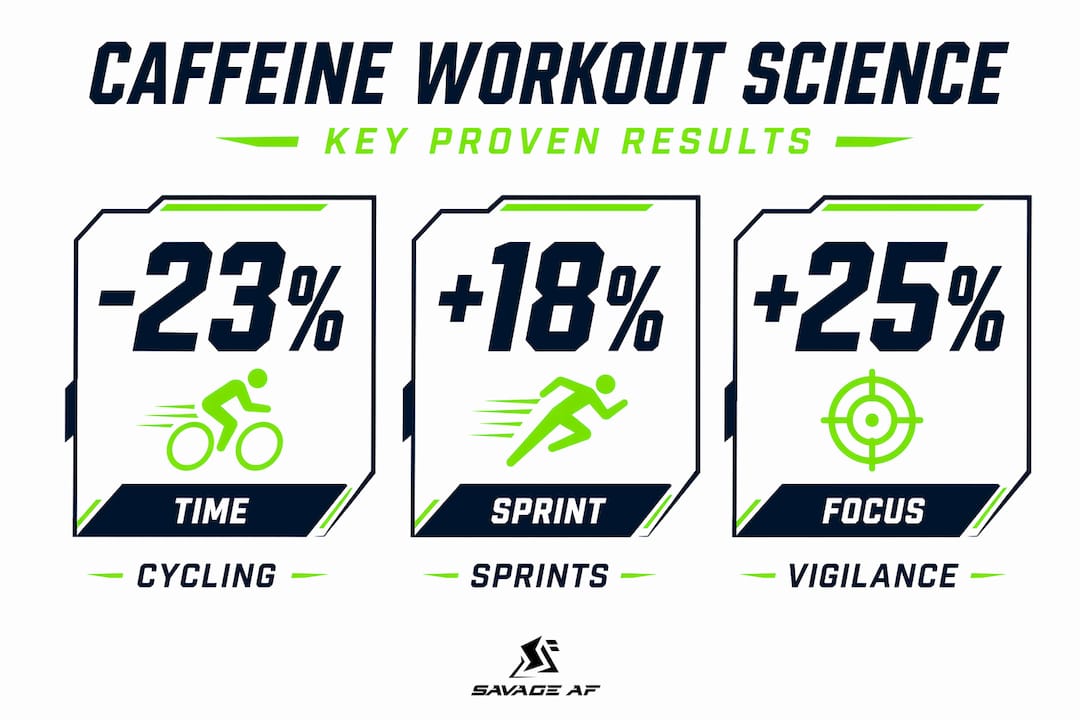
A systematic review and meta-analysis of 20 cycling studies found that acute caffeine ingestion reduced completion time with an SMD of 0.36 and increased mean power output with an SMD of 0.29. Critically, low doses at or below 3 mg/kg were just as effective as higher doses for cycling performance. You don’t need to overdose to compete.
| Exercise Type | Key Benefit | Performance Change |
|---|---|---|
| Endurance cycling | Reduced time to complete | SMD 0.36 improvement |
| Mean power output | Increased wattage sustained | SMD 0.29 improvement |
| Intermittent sprint (team sport) | Total work done | 6.2% and 5.3% increases per half |
| Morning neuromuscular output | Matched evening performance | RPE attenuated, EMG higher |
| Cognitive and reaction tasks | Vigilance and reaction time | Significant across menstrual phases |
For team-sport athletes doing repeated sprints, the data is just as sharp. Caffeine before sprint-based work increased total work output by over 6% in the first half and more than 5% in the second, while lowering perceived exertion and breathing difficulty. The fact that output held in the second half tells you something important. This isn’t just a first-rep boost. Caffeine’s benefits are clearest when performance is limited by central fatigue rather than purely by metabolic depletion.
For women specifically, 400 mg of caffeine improved vigilance and reaction time across all menstrual cycle phases in trained athletes. Physical performance effects were less consistent, but cognitive and neuromuscular advantages held firm. If you’re a female athlete who has dismissed caffeine because you weren’t sure it works for you, the data says otherwise, at least for mental sharpness and sprint endurance.
Pro Tip: Context-dependent response is real. Endurance and sprint tasks show the clearest gains from caffeine. If you’re testing it for pure strength work like a one-rep max, expect smaller and less predictable effects.
Nuances, limitations, and potential downsides
Caffeine is powerful. It is not flawless. And if you use it without understanding its limits, you’ll blunt your own gains.
The biggest wake-up call comes from the data on long-term exposure. High, continuous caffeine intake reduces muscle protein synthesis by 30 to 70% in vitro and reduces tendon collagen synthesis and strength by roughly 45%. That means the same stimulant helping you train harder could be quietly working against your ability to build the muscle and connective tissue that hard training is supposed to create. Acute performance is up. Long-term adaptation is compromised. That’s a trade-off worth understanding.
Habitual use matters too. Caffeine-naive athletes experience stronger acute effects at the same dose. Tolerance develops with habitual use, and regular consumers see blunted responses. Cycling your intake, meaning taking deliberate breaks, restores sensitivity and keeps caffeine in your arsenal as a weapon, not a baseline requirement.
Here’s what else to watch:
- Cardiovascular stress: Caffeine raises heart rate and systolic blood pressure during training. For most healthy athletes this is manageable. For those with cardiovascular risk factors or predispositions, this is a real concern, especially at high doses.
- Stimulant stacking: Combining caffeine with other stimulants amplifies cardiovascular stress without proportionally increasing performance. Not worth it.
- Age and sex variation: Older athletes may actually benefit more from caffeine in cycling performance than younger athletes, based on meta-regression data. Women’s physical performance responses vary by task and cycle phase. One-size-fits-all dosing is lazy.
- Sleep disruption: Using caffeine too late in the day destroys sleep quality. Destroyed sleep kills recovery, growth hormone release, and your next session’s output. You can’t out-supplement bad sleep.
Caffeine used strategically is a weapon. Caffeine used carelessly is a tax on your future gains. The difference is discipline.
Practical guidelines for using caffeine before workouts
You know the science. Now use it like an athlete, not a guy crushing energy drinks at 11 PM wondering why his bench press isn’t moving.
-
Dose at 3 to 6 mg/kg of body weight. A 180 lb (82 kg) athlete targets roughly 245 to 490 mg. Start at the low end and assess tolerance before going higher. Low doses already match high doses for many endurance metrics.
-
Time it 45 to 60 minutes pre-training. That’s when plasma caffeine peaks. Taking it too early means peak concentration happens at warm-up. Taking it too late means you’re past peak during your hardest sets.
-
Match your dose to the training type. Endurance sessions and sprint-based work see the strongest, most consistent gains. For max strength days, caffeine helps via CNS excitability and focus, but don’t expect your one-rep max to skyrocket.
-
Cycle your caffeine use. Take deliberate low-caffeine or no-caffeine days, especially on deload weeks or rest days. Reassemble your sensitivity. When you come back to a full dose, the effect hits harder.
-
Female athletes should personalize their testing. Cognitive performance and vigilance benefits are consistent across the menstrual cycle. Physical performance effects vary. Track your response across training phases rather than relying on averages.
-
Pair caffeine with creatine for strength and endurance. These two compounds work through different pathways and stack well without cardiovascular overlap.
Pro Tip: If you train fasted in the morning, caffeine on an empty stomach hits faster but can cause nausea for some. A small amount of food doesn’t kill absorption. It just shifts peak concentration by 15 to 30 minutes. Test it.
You can also explore protein shake timing around your sessions to build a full pre and post-workout protocol that works with your caffeine strategy, not against it.
My honest take after years in the trenches
I’ve watched athletes treat caffeine like a crutch and athletes treat it like a scalpel. The ones who got better results over time were always the ones with discipline around it.
Caffeine is genuinely powerful. I’ve seen it pull athletes out of flat morning sessions and sharpen focus during the last brutal sets of a high-volume squat day. The neuroscience backs every bit of that up. But I’ve also seen guys who couldn’t train without 600 mg of caffeine stacked with everything else in their pre-workout, wondering why their muscle growth stalled. That data on protein synthesis reduction is not theoretical. It shows up in the physique over time.
My take: reserve full-dose caffeine for the sessions where output matters most. Competition days. Heavy lifting days. High-intensity conditioning. Not every Tuesday spin class. Use the off-days to let your receptors reset, and consider non-stim alternatives when you want the pump without the adrenal load.
The athletes who stay sharp for years treat caffeine as a strategic tool. Not a daily survival requirement. That mindset is what separates competitors from people who just work out.
— Ronnie Savoie
Savage AF gear to take your training further
You’ve got the caffeine protocol locked in. Now stack it with fuel that’s actually built for athletes who refuse to quit.
Savageaf’s lineup is engineered for the kind of athlete this article was written for. If you’re training twice a day, playing shows on weekends, or just refuse to leave anything in the tank, the Savage AF supplement collection covers every angle from hard pre-workout formulas to recovery proteins and muscle-building creatine gummies. For sessions where you want pump and endurance without stacking more stimulants on top of your caffeine, the Primal Surge No-Stim pre-workout is the play. Same vasodilation and performance drive. Zero additional CNS load. Smart caffeine use plus smart supplementation is how you build a body that performs for years, not just weeks.
If you’re also exploring herbal and natural energy sources to complement your caffeine protocol, that’s a legitimate strategy for recovery days and lighter training phases.
FAQ
How much caffeine should I take before a workout?
Research supports 3 to 6 mg/kg of body weight taken 45 to 60 minutes before training. For most athletes, that falls between 200 and 400 mg depending on body mass and tolerance.
Does caffeine help with strength training specifically?
Caffeine improves CNS drive and motor unit recruitment, which supports strength performance, but its most consistent and measurable gains appear in endurance and sprint-based tasks rather than one-rep max efforts.
Can I build tolerance to caffeine’s workout benefits?
Yes. Habitual caffeine users show blunted performance responses. Cycling your intake with regular low-caffeine or no-caffeine periods restores sensitivity and keeps the ergogenic effect sharp.
Is caffeine safe for every athlete?
Most healthy athletes tolerate caffeine well at moderate doses, but individuals with cardiovascular risk factors should use caution since caffeine transiently raises heart rate and blood pressure during exercise, especially at higher doses.
Does caffeine affect female athletes differently?
Cognitive benefits like vigilance and reaction time are consistent across menstrual cycle phases. Physical performance effects vary more, so female athletes should track their individual response rather than apply a standard protocol.


