


Nitric oxide (NO) is defined as a gaseous signaling molecule produced by the body that drives vasodilation, mitochondrial efficiency, and muscle oxygenation during exercise. The role of nitric oxide in performance is not a marketing myth. It is a documented physiological mechanism that separates athletes who recover fast and push harder from those who gas out early. NO is synthesized through two primary pathways: endothelial nitric oxide synthase (eNOS) enzymes and the nitrate–nitrite–NO pathway, the latter activated by dietary nitrate sources like beetroot juice. If you train with intensity and want every biological advantage working for you, understanding NO is non-negotiable.
How does nitric oxide enhance blood flow and muscle oxygenation during exercise?
Nitric oxide relaxes vascular smooth muscle by activating eNOS signaling in the endothelium, causing blood vessels to widen and deliver more oxygen-rich blood to working muscles. This vasodilatory effect is the foundation of every “pump” you feel mid-set, but the real payoff goes far deeper than aesthetics. Improved skeletal muscle perfusion means your fibers get more fuel, clear waste faster, and sustain output longer. The nitrate–nitrite–NO pathway becomes especially critical under hypoxic conditions inside contracting muscle, where oxygen is scarce and the body needs an alternative NO production route to keep performance from collapsing.
Beyond blood flow, NO directly enhances mitochondrial efficiency. Your mitochondria produce ATP with less oxygen per unit of work, which translates to a measurable reduction in the oxygen cost of exercise. That efficiency gain is what lets you hold a hard pace longer before hitting the wall.
Key mechanisms driving NO’s vascular and metabolic impact:
- eNOS activation in endothelial cells triggers smooth muscle relaxation and vessel dilation
- Dietary nitrate from beetroot juice converts to nitrite in saliva, then to NO in hypoxic muscle tissue
- Improved capillary perfusion accelerates lactate clearance and delays fatigue
- Enhanced mitochondrial coupling reduces oxygen demand at submaximal intensities
- Post-exercise reoxygenation speeds up, cutting recovery time between hard efforts
Pro Tip: Your oral microbiota are the gatekeepers of nitrate conversion. Antibacterial mouthwash kills the bacteria that reduce nitrate to nitrite in saliva, wiping out a significant portion of your NO production from dietary sources. Skip the mouthwash before training if you’re using nitrate-based supplements for performance.
What does the research say about nitric oxide supplementation and performance gains?
The science on nitric oxide supplementation is clear on one thing: endurance and high-intensity intermittent efforts respond the most. Dietary nitrate reduces oxygen cost of submaximal exercise by approximately 5%, improving time-to-exhaustion and time-trial performance in efforts lasting 2 to 30 minutes. That 5% sounds modest until you realize it represents the difference between a podium finish and watching someone else celebrate.
Meta-analyses confirm performance gains are most consistent in aerobic endurance and high-intensity intermittent exercise. Nitrate supplementation benefits aerobic activities more reliably than anaerobic or pure strength work, with recreational athletes gaining more than elite competitors. The ceiling effect in highly trained athletes is real, but that does not mean NO supplementation is useless at the top level. It means the gains are smaller and require smarter dosing.
On the anaerobic side, acute beetroot juice ingestion at 12.8 mmol nitrate improved peak power by ~11% and mean power by ~7% in trained football players during a 30-second Wingate test. Post-exercise muscle oxygen saturation also increased by ~10%, pointing to faster recovery between explosive efforts. That is a meaningful number for any athlete whose sport demands repeated sprint capacity.
| Exercise modality | Nitrate supplementation effect | Consistency of evidence |
|---|---|---|
| Aerobic endurance (2–30 min) | ~5% reduction in oxygen cost, improved time-to-exhaustion | High |
| High-intensity intermittent | Improved repeat sprint capacity, faster reoxygenation | Moderate to high |
| Anaerobic power (Wingate) | ~11% peak power increase, ~7% mean power increase | Moderate |
| Maximal isometric strength | Minimal to no improvement | Low |
| Vascular/endothelial function | Consistent improvement in flow-mediated dilation | High |
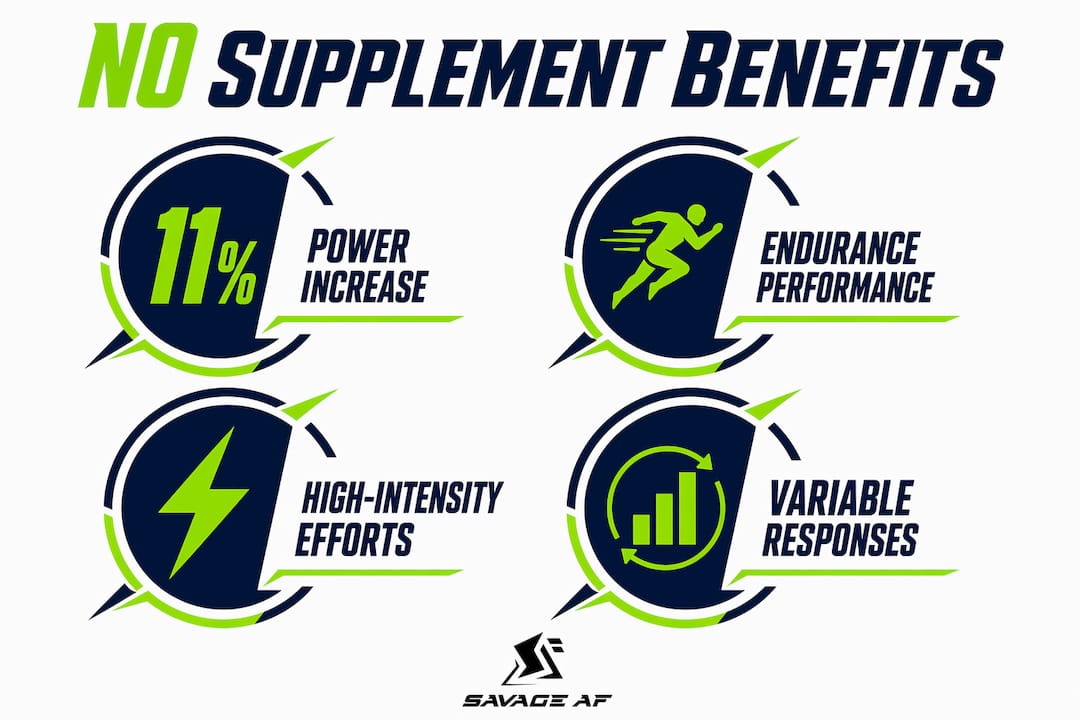
The ergogenic benefits of NO are most evident in time-to-exhaustion and time-trial performance rather than isolated strength outcomes. If your sport involves sustained effort or repeated high-intensity bouts, NO supplementation belongs in your protocol.
How consistent and reliable are nitric oxide supplementation results across different athletes?
Not every athlete responds to nitrate supplementation the same way. Significant inter-individual variability in outcomes exists, driven by differences in physiology, training status, oral microbiota composition, and dosing. The “non-responder” phenomenon is documented and real. Some athletes show no measurable performance change despite adequate nitrate intake, and that frustration is valid. The solution is not to abandon NO strategies. It is to test and adjust.
Elite athletes face a ceiling effect because their cardiovascular systems are already highly adapted. Their baseline NO production from exercise training is elevated, leaving less room for dietary nitrate to add on top. Exercise training enhances endogenous NO production through eNOS upregulation, which partly explains why recreational athletes see bigger percentage gains from supplementation than professionals.
Dosing matters more than most athletes realize. Research shows that 400 mg nitrate improves macrovascular endothelial function, while aortic systolic blood pressure improvements require 800 mg. Plasma cGMP does not change across doses, which means the vascular response is dose-specific and not a simple linear relationship. Guessing your dose is leaving performance on the table.
Factors that determine your individual NO response:
- Oral microbiota diversity and density of nitrate-reducing bacteria
- Training status and baseline eNOS activity
- Nitrate dose and timing relative to exercise
- Dietary habits, including vegetable nitrate intake from sources like spinach and arugula
- Use of antibacterial products that disrupt salivary nitrate conversion
Pro Tip: Run a 2-week nitrate loading protocol with a standardized beetroot juice product like those profiled on Nitrosigine research pages, then test performance on a time-trial effort you can repeat reliably. Compare results before and after. That is the only way to know if you are a responder without guessing.
How does nitric oxide influence recovery and muscle contractile function?
NO does more than open blood vessels during your set. It reaches inside the muscle fiber and changes how it contracts. Nitrate supplementation elevates calsequestrin and improves calcium release and reuptake in the sarcoplasmic reticulum, making each contraction more mechanically efficient. This is especially relevant for Type II fast-twitch fibers, which are the fibers you rely on for explosive power and heavy lifting. More efficient calcium handling means more force per unit of metabolic cost.

Post-exercise recovery gets a direct upgrade from NO as well. The 12.8 mmol beetroot juice protocol that boosted Wingate power also increased post-exercise muscle oxygen saturation by ~10%. Faster reoxygenation after a hard effort means your muscles are primed for the next round sooner. For athletes doing interval training, circuit work, or back-to-back competition days, that acceleration in recovery is a genuine competitive edge.
Practical recovery benefits NO delivers to serious athletes:
- Faster phosphocreatine resynthesis between high-intensity bouts
- Improved calcium cycling in Type II fibers for sustained explosive output
- Accelerated post-exercise muscle reoxygenation reducing soreness and fatigue
- Enhanced repeated-bout capacity during interval sessions and multi-event competition
- Synergistic effects with creatine supplementation for maximum performance output
The role of NO in muscle growth is indirect but real. Better blood flow delivers more amino acids and anabolic hormones to recovering tissue. More efficient contractions reduce unnecessary mechanical stress. Faster reoxygenation lets you train harder, more often. Stack those effects over months of consistent training and the cumulative impact on muscle development is significant.
Key takeaways
Nitric oxide enhances athletic performance by reducing oxygen cost, improving muscle oxygenation, and accelerating recovery through vasodilation and mitochondrial efficiency.
| Point | Details |
|---|---|
| NO reduces oxygen cost | Dietary nitrate cuts submaximal exercise oxygen demand by ~5%, extending endurance capacity. |
| Endurance gains are most reliable | Aerobic and high-intensity intermittent efforts respond more consistently than pure strength work. |
| Dose determines vascular response | 400 mg nitrate improves endothelial function; 800 mg is required for aortic blood pressure effects. |
| Oral microbiota matter | Antibacterial mouthwash disrupts nitrate-to-nitrite conversion, reducing NO bioavailability. |
| Recovery accelerates with NO | Post-exercise muscle oxygen saturation increases ~10%, speeding reoxygenation between hard efforts. |
Why I think most athletes are using NO supplements wrong
I have watched athletes load up on nitrate pre-workouts expecting a strength explosion and then write off NO entirely when their one-rep max does not move. That is the wrong test. Nitrate supplementation primarily benefits aerobic activities and high-intensity intermittent work. If you are testing it on a max bench press, you are measuring the wrong variable.
The athletes who get the most out of NO strategies are the ones who use it for what it actually does: sustaining hard efforts longer, recovering faster between rounds, and keeping output high across repeated sprints or intervals. I have seen endurance athletes shave meaningful time off 20-minute time trials with consistent nitrate loading. I have seen fighters and team sport athletes maintain power output deeper into training sessions. That is where NO earns its place.
The other mistake is inconsistency. NO supplementation is not a one-shot deal. Oral microbiota need time to adapt, and the exercise-induced changes in salivary flow that influence nitrate conversion build over time with regular training. Treat it like a training block, not a pre-game ritual. Test your response, dial in your dose, and stack it with a training program that actually demands what NO delivers. No excuses. No shortcuts. Just work backed by biology.
— Ronnie Savoie
Fuel your NO pathways with Savageaf
Savageaf builds supplements for athletes who do not accept average. If the science on nitric oxide has you ready to attack your next training block with a real physiological edge, Primal Surge No-Stim Pre-Workout is built to support pump, endurance, and sustained output without stimulant crash. Stack it with Beast Bites Creatine Gummies to cover the recovery and strength side of the equation. NO opens the door. Creatine kicks it down. Explore the full performance supplement lineup and build a protocol that matches your intensity.
FAQ
What is the role of nitric oxide in exercise performance?
Nitric oxide drives vasodilation, improves oxygen delivery to working muscles, and enhances mitochondrial efficiency, reducing the oxygen cost of submaximal exercise by approximately 5%. These effects directly improve endurance, power output, and recovery speed.
Does nitric oxide supplementation enhance performance for all athletes?
No. Response varies by training status, oral microbiota composition, and dosing. Recreational athletes typically see larger gains than elite athletes, who have higher baseline NO production from training adaptation.
What is the best dietary source of nitrate for boosting nitric oxide?
Beetroot juice is the most studied dietary nitrate source, with protocols using 12.8 mmol nitrate showing measurable improvements in both endurance and anaerobic power output. Spinach, arugula, and celery are also high-nitrate food sources.
How does nitric oxide support muscle recovery?
NO accelerates post-exercise muscle reoxygenation and improves calcium handling in the sarcoplasmic reticulum, allowing faster recovery between hard efforts and more efficient repeated contractions during interval-based training.
Why does mouthwash reduce nitric oxide benefits from supplements?
Antibacterial mouthwash kills the oral bacteria responsible for converting dietary nitrate to nitrite in saliva. Without that conversion step, the nitrate you consume cannot enter the nitrate–nitrite–NO pathway, cutting your NO production from dietary sources significantly.


